To Bebop or Not To Bebop: All Night Long Tackles Race, Gender, and Shakespeare with a jazz score
Composed for Info 285-16 – Dr. Donald Westbrook for the MLIS program at San Jose State University
By Julia Devine
April 27, 2021
Abstract
This paper explores the 1962 British film All Night Long, directed by Basil Dearden, and how it interprets Shakespeare’s Othello set in a contemporary modern jazz milieu. The history of production, the integrity of the jazz performances, as well as the various themes it tackles, such as racial tensions and gender issues are laid out, along with the argument that the female roles are much more developed and have stronger personalities than in the original play text.
Keywords: Othello, jazz, racial tension, gender roles, British social issue films
Introduction
In 1962, a very interesting and overlooked film directed by Basil Dearden was distributed by the British film company Rank. It loosely incorporated the plot of the Shakespeare play Othello, while transporting the basic elements and characters into the contemporary jazz scene, featuring renowned musicians Dave Brubeck and Charles Mingus, playing music in and for the film, and basically portraying themselves. With the genuine milieu of racial interaction, it was a daring script (co-penned by blacklisted Paul Jarrico) for the time period, and later critiques have led to much discussion among scholars as to the racial perspectives. Another angle that has not gotten as much attention, is the interpretation of how this version changes and interprets the gender roles. The Shakespeare text (and the time period in which it was written) did not lend itself to strong female characters, so the film version is as interesting from that perspective as it is from the topics of miscegenation and racial tensions, as well as the unique filmic capture of some iconic jazz performers in their prime.
History of the Production
Oddly enough, the idea for the film project (a jazz music version of Othello) seems to have originated with producer Alfred Crown (who later produced a filmed stage version of Richard Burton performing Hamlet) (IMDB, 2021), who titled it The Night They Waited. He brought this concept to blacklisted writer Paul Jarrico (who was ultimately billed as Peter Achilles) and teamed him with jazz enthusiast and editor Nel King.
They sketched out the basic premise, but originally set the scene in a Manhattan loft. Renamed All Night Long, Crown wanted more extensive rewrites and also communicated that slated distributor United Artists would only tackle the project if Lena Horne played the Desdemona role, which Jarrico and King believed changed their main plot focus, which was centered on the theme of miscegenation (Ceplair, 2007).
Jarrico flew to London to present the script to producer Bob Roberts (who had also been a victim of the blacklist), hoping that he would buy it from Crown and then slate Jarrico to direct. He did purchase the script, but instead selected the established British director Basil Dearden. Jarrico was henceforth disappointed by the lack of black personnel involved in the project (Ceplair, 2007), even though King had been instrumental in getting legendary jazz bassist Charles Mingus involved in the production (Gabbard, 2016).
Dearden, with producer Michael Relph, was already known for tackling controversial social subjects. Previous to All Night Long, they had made Sapphire (1959), a very overt treatment of racial issues surrounding a murdered young woman who had “passed as white,” and Victim (1961) about the blackmail of a homosexual lawyer. These were both distributed by Rank, who they worked with after Ealing studios, and up to 1962 (McFarlane, 2007). Jarrico’s biographer Ceplair (2007) claims (with no evidence provided) that “Dearden liked neither jazz nor black people,” but Mingus historian Gabbard (2016) states that he wanted to be in the film, at least partly because of the director’s reputation for addressing “taboo subjects.” In fact, Dearden is quoted as saying that the aim of Sapphire was to “show this (colour) prejudice as the stupid and illogical thing it is,” and it also used a jazz soundtrack (also written by Phillip Green), dance clubs, and a performance by Johnny Dankworth (Young, 1996).
The lineup of jazz musicians who played in the film (and some of whom wrote songs specifically for the soundtrack) was stellar. In addition to Mingus, the other American involved was keyboardist Dave Brubeck, and the group was rounded out with prominent British musicians Johnny Dankworth, Tubby Hayes, and Johnny Scott, who are spotlighted in solo turns. According to the soundtrack reissue liner notes by Michael Heatley (Brubeck et al., 2015), Brubeck and Mingus just happened to be touring in the area (contrary to what Gabbard writes about Nel King getting Mingus involved), and were invited to participate by jazz critic Benny Green. To some critics, these scenes alone were well worth the price of admission. Lanier (2005) laments that Mingus, as the only prominent black musician of the cast seems to be “shunted to the margins,” and notes that his duet with Brubeck “occupies less than 30 seconds of screen time and constitutes his longest appearance in the film.” Brubeck and Mingus had known each other from the San Francisco jazz scene, and Brubeck relates that (Lees, 1995), “We were really close for years,” although this is their only instance of performing (and recording) together.
Producer Michael Relph originally started in film as a set designer, and he returns to this role in addition to his producer credit, to create the magnificent dockside warehouse set (with large modern art canvas backdrops and a circular staircase as a central focus) for the after-hours private jazz-session anniversary party. Although most of the film is shot on this set at Pinewood Studios, there are a few scenes, mainly at the beginning and end, that are located in authentic London streets, some in the industrial wharf area where the warehouse is purported to be located (Wilkinson, 2017). Along with striking cinematography and camera movement by Ted Scaife, the result is as visually arresting as it is aurally pleasing.
Although there seems to be very little documentation on the selection of the cast, Dearden and Relph had previously used Patrick McGoohan (who coincidentally would go on to direct his own musical version of Othello, Catch My Soul from 1974, set outside Santa Fe, New Mexico, and starring musicians Richie Havens, Lance LeGault, and Tony Joe White) in Life for Ruth. His role as jazz drummer, Johnny Cousin parallels the scheming Iago, who is here turned into the foreground character. Fans of McGoohan’s groundbreaking television series The Prisoner (1967-1968) might be startled to hear him state that series’ trademark line, “Be seeing you,” in this film that was shot six years earlier. The film also uses punctuations of thunder throughout, which was used to great effect in the opening sequence of the TV series. I could find no clues as to whether he had improvised his favorite phrase, or later appropriated it from Jarrico’s script.
Richard Attenborough (who plays the rich jazz backer, Rod, matching Roderigo in the original source) was also one of their stock actors (McFarlane, 2007). I could find nothing written about the casting of Paul Harris, Keith Michell, Marti Stevens, and Maria Velasco (Aurelius Rex/Othello, Cass/Cassius, Delia/Desdemona, and Benny/Bianca). Betsy Blair (in the role of Emily/Emilia) was another American who was in England because of the blacklist. In her autobiography she notes her friendship with screenwriter Jarrico, and recollects, “The film was okay. Dave Brubeck was in it, so the music was great. And for me, it turned out to be the most important job I ever had.” This was because she met her second husband (her first being Gene Kelly), Karel Reisz, while he was also at the studio, directing This Sporting Life(Blair, 2003).
Literature Review
Critics of the time didn’t know what to make of Basil Dearden’s stylish Shakespeare update. It didn’t quite fit in with his social realist dramas, and the idea of Othello set in the contemporary London jazz scene appeared either jarring or melodramatic to some. In the intervening years, scholars have approached the film in various ways, mainly focusing on one or several aspects of the film and treatment: how the film dealt with gender, how the film dealt with race, how that was reflected by the jazz scene setting, how the jazz scene and performers were reflected and incorporated into the milieu, and the way that the script interpreted the Shakespeare original. Within the racial perspective, there was contained a left-leaning political perspective, highlighted by a number of blacklisted cast and crew members.
Jazzin’ Up the Scene
Some scribes were mainly infatuated with the musicians and music in the film, and wrote solely on this topic. Others noted the amazing performances and score, and went on to comment on the aptness of the genre to reflect the race issue prevalent in the source material.
Central to the musical ensemble was internationally respected white keyboardist and composer, Dave Brubeck, who was also commissioned to write material for the soundtrack. Vying for famousness was black bassist Charles Mingus, almost as known for his prickliness as his musical abilities. Gabbard (2016) writes that “Mingus did not hit it off with Philip Green, who was hired to provide background music when the jazzmen were not performing on camera.” Despite this, he was able to get one of his songs into the background music. In addition, noted musicians Johnny Dankworth (who, along with Green, also worked on Dearden’s Sapphire soundtrack), Tubby Hayes, and Johnny Scott also performed and appeared as themselves (Lanier, 2005). Jazz chanteuse Cleo Laine dubs in the vocals for actress Marti Stevens in her two numbers. Francis (2008) devotes a piece to the sole unlikely instance of Brubeck and Mingus playing together, which happens in the film, and includes Brubeck’s own anecdote of the union. That recording produced their version of Mingus’ Non-Sectarian Blues, which was unreleased until 1971.
Race in Jazz and Othello
Many writers took the perspective that the jazz scene was the perfect realm to approach a central racial topic, because of its African-American origins and its devotees’ status as color blind. However, there were a few who took the outlook that the film’s nonchalant attitude toward race was an instance of trying to ignore or gloss over the topic, the opposite of Dearden & Relph’s earlier Sapphire, where the dialog about race and interracial sexual relations was extremely upfront and central to the whole film (Young, 1996).
Although Lanier (2005) writes “Striking is the extent to which the film mutes the source play’s concern with racism,” yet he later concludes that “…we are given a disturbing image of the persistent racial anxieties and tensions that lurk just below the surface of his jazz utopia.” Földváry (2020) takes the view that “…here the racial aspect is less explicit, although clearly significant, as in the world of jazz being black appears to be an enviable position.” In fact, Cousin tries to make a joke (with the recipients having a slow, strained response) by stating that “I belong to that new minority group: white American jazz musicians. We’re going to hold a mass meeting in a phone booth.”
To the scriptwriters Jarrico and King, the interracial marriage at the center was certainly an integral element of the plot. As Ceplair (2007) relates in his biography of Jarrico, their original producer reported that United Artists would only distribute the film if Lena Horne would play the Desdemona character. “Jarrico and King angrily responded that such casting defeated the whole point of the screenplay, which was the issue of miscegenation.” Besides the central pairing of Delia and Rex, white musician Cass has a black girlfriend, Benny, and in real life several of the cast members had interracial marriages: Johnny Dankworth was married to the amazing jazz singer Cleo Laine (Lanier, 2005). In a blur of reality vs. script, Rod greets Dankworth with “I’m so sorry Cleo couldn’t make it tonight.” And Charles Mingus (who had several white wives) later married Sue, who early in their courtship went to Shakespeare in the Park, with James Earl Jones playing Othello (Gabbard, 2016).
Indeed, Skrebels (2008) agrees that “…the film confronts Othello’s interracial theme head-on, by the paradoxical but clever decision initially to avoid the question of race.” Felsenthal (2019) feels that the studio’s intervention kept away any sort of real social issue progress. “The reticence of studio executives to make progressive films persisted, however, which is why the social utopia of All Night Long turns bizarrely dystopian by its end.” And he also took a dim view of the intentions of the production team, “Dearden and Relph were notable among British filmmakers for making movies about taboo social issues, which did not mean that their perspectives on race were forward-thinking.”
Interpreting Shakespeare Through a Contemporary Lens
Howard (2010) references the shift of focus from Othello to Iago in this script, which also subverts the ending, “…tragedy is averted and McGoohan ends the film alone and shunned…” In fact, the ending is probably one of the most prominent topics for comment as far as the interpretation of the Othello theme. Földváry (2020) states, “The ending is certainly a decisive aspect in terms of the film’s genre: by discarding the tragic ending of the original, the filmmakers shifted the dominant mode towards the melodrama.”
Skrebels (2008) feels that the jazz milieu is the perfect construct for this interpretation, “…a device that generates, focuses, and sustains the dramatic action of Shakespeare’s play, while deftly redeploying and even refining that action…” He also notes that, “…the film merits attention as an informed and intelligent example of the way variants maintain the dialogue between their source texts and the circumstances of their representation.”
Several critiques mention the clever ways that plot points are translated into the music realm, such as Johnny Cousin (the Iago character) using a then high-tech tape recorder (owned by the wealthy Rod) to capture Cass’ discussion of his relationship with Benny, only to then splice the tape in order to make it appear that the conversation was about Delia (Burton & O’Sullivan, 2009; Skrebels, 2008). And some note the link between the Willow Song in the original text, the later musical interpretation by Verdi, and Delia’s singing numbers in the film version to demonstrate how this particular play seemed very open to musical interpretations (Burton & O’Sullivan, 2009; Hodgdon, 1991; Howard, 2010).
Female Perspectives
Lastly, a few sources tackle the area of gender treatment either in the text, or the film. Levenson (2012) notes that versions of Othello existed even before Shakespeare, and comments that his later Folio version (as opposed to the previous Quarto) provides “…a more complex and sensual Desdemona…” She also mentions the extended dialogues between Desdemona and Emilia, which deepen their relationship, although these additions are not evident in the character of Bianca. However, in the play, Desdemona is hardly more than a pawn in the power games orchestrated by Iago.
Barbara Hodgdon (1991) attempts to interpret the Shakespeare text (and some versions of it) through the female perspective, “…women’s melodrama and soap opera, genres which, in representing social realities from a gendered point of view, attempt to negotiate a space within patriarchal domination that exposes and contests its power over the female body and voice.” In All Night Long she argues that the central issue of the film is male control of the female voice. Delia’s two disparate songs represent aspects of her character as interpreted through the men in her life: the passive romantic ballad (demonstrating her possession by Rex) and the bebop-influenced self-confident number that she credits to the direction of Cass (see Fig 1, where during the ballad she appears to be caged behind the stair rail). At the end, Emily’s voice is drowned out by her husband’s drumming, as he flails in conquering the only object he now has control over, his drum set.
But Hodgdon (1991) does admit that the male gaze within the film aligns Delia on equal footing, and from the presence of her own talent, not as a sexual object, although she feels that this is at the expense of undermining the representation of Emily, who she ties in with actress Betsy Blair’s own real-life struggle to interpret Othello (she was slated, then passed over to play Desdemona in Orson Welles’ 1951 version, then relegated to a tiny Emily part in another film interpretation, George Cukor’s A Double Life (1947), written by wife and husband, Ruth Gordon and Garson Kanin. Földváry (2020) perceives that the women “present a powerful image of female position,” but also believes that they are represented primarily as victims of manipulation.
Gender Roles in Othello and All Night Long
As Levenson (2012) notes the more fully developed characters of Desdemona and Emilia in Shakespeare’s Folioversion of Othello, she also notes the increased violence toward those women by their husbands, who ultimately murder their wives. In fact, when Verdi composed his opera version, his take on the Desdemona character (as noted in a letter) is that she is simply a “type,” as in a caricature, “of goodness, of resignation, of sacrifice!” (Levenson, 2012).
Fig. 1
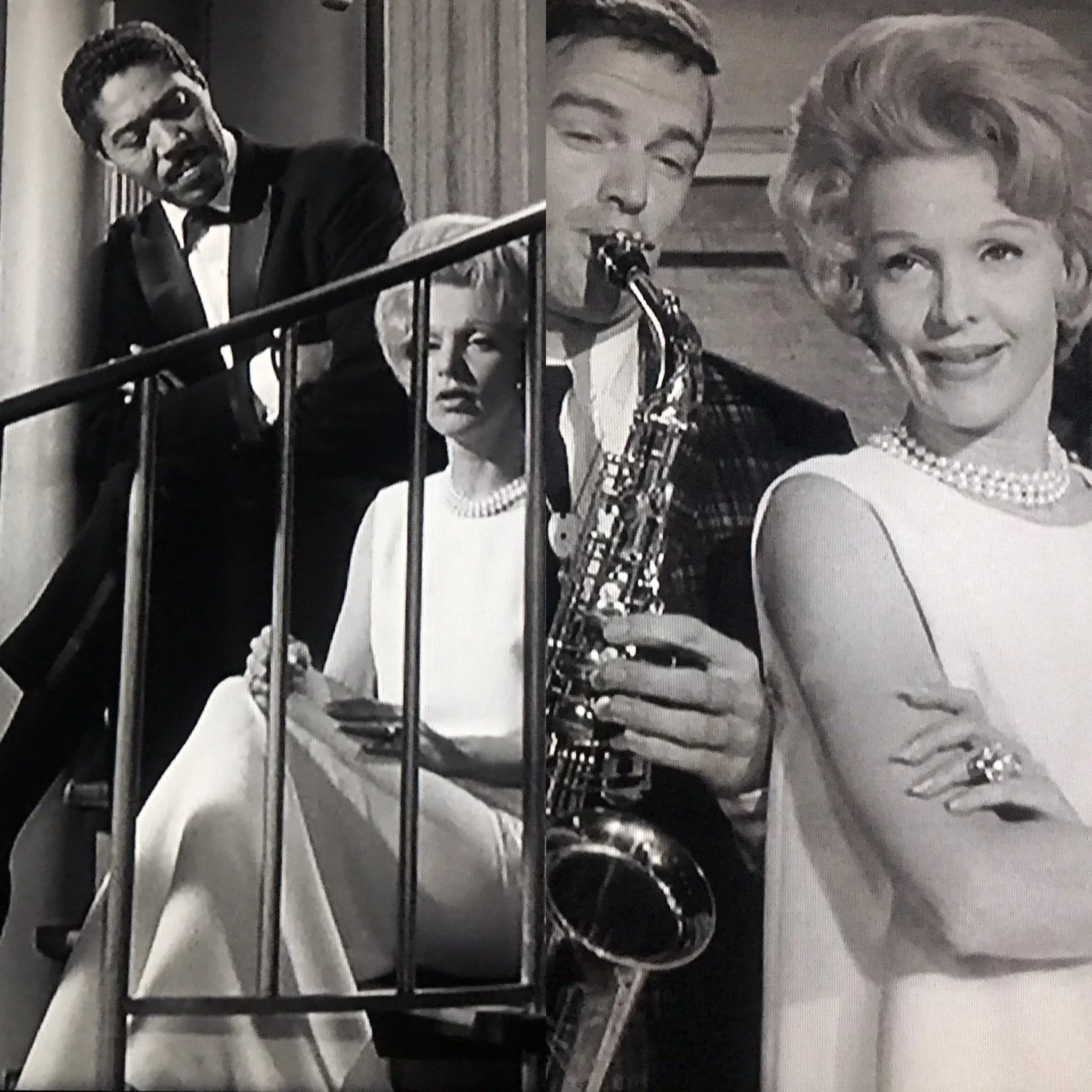
Hodgdon (1991) is more interested in the “gaze” as it exists in the play and film versions, where the perspective angles shift between the male and the female view. But she doesn’t seem to address the power and emotional roles that the men and women take in either the play or the film version of All Night Long.
Primary to the changes made from the Shakespeare text to this film version is the power of the female characters and their centrality to the plot. Unlike the Shakespeare play (n.d.), where Iago wants Cassius out of the way so that Othello will appoint him as Lieutenant, in All Night Long, Johnny Cousin wants Aurelius Rex (whose name and jazz style are reminiscent of Duke Ellington, including his playing several of his songs) out of the way so that he can have Delia sing in his band. Unlike the military-themed play, where his ranking under Othello would bring Iago power, it is the reputation and talent of Delia that would lift Cousin’s ranking and bring both acclaim and monetary success to him as a bandleader.
The women are the stable, rational individuals, and the men are irrational, emotional and unhinged. Similar to the Shakespeare original, Emily is a loving presence who (although the only woman who overindulges in “juice”) is loyal to her friend, and also understands her husband’s duplicitous nature. Unlike the play, where he murders her, here when Emily tells the party crowd of his lies, she is forgiving because she loves him despite his narcissistic tendencies.
I would argue that the men in All Night Long stand in weaker roles and positions of power than in the Shakespeare play. Although Rex does start to strangle Delia (in a quite disturbing scene), he stops when she tells him that she loves him, and they soon reconcile when Johnny Cousin is exposed by his wife as a liar. Cousin also does not kill Emily, but instead drowns out her voice with his own and his drums. Earlier, he had silenced her when she asked what he was planning. “Now whatever I’m doing, it’s my business, understand? Stay out of it, don’t ask questions, don’t talk, that way we’ll get along fine.” In fact, the most violent incident in the film, is not against a woman, but another man.
Many of the party ensemble’s disdain for Cousin is made quite clear early in the film. As he makes his entrance to the party, he barks orders at his underlings toting his drumkit. He shouts out a greeting to all, grandly announcing his entrance. Benny notes that he won’t use Rod’s drums because, “They don’t have his name on them.” This is contrasted by the arrival soon after of his wife, Emily, who quietly walks in and is quickly and warmly greeted by Rod and some musicians who come over to see her. It is clear that even though they feel sorry for her (Benny asks Cousin where his “poor little wife” is at) Emily is much revered by the clique. Later when Emily confesses the less-than-romantic circumstances of their marriage, Delia asks her, “Is he mean to you?” She replies, “It sounds funny, but I’m sorry for him.” Despite his renowned talent, his wife is a much stronger person, both in her standing in the community, and emotionally, and has no problem calling him out for his misdeeds when they effect other people’s lives.
Delia is even more secure and stable a presence, since she feels that her marriage is a happy one. She is revered by both musicians and fans for her talent, and she is very clear about doing what she wants (even if she does state at one point, “I have found out what I am. A domestic animal”). She made the decision to leave her career for her marriage, and is very firm with all the men that try to coax her back to the spotlight. And in her musical numbers (that she agreed to perform as a surprise to Rex for their anniversary party), she is fully in control of the situation, a consummate professional.
Cousin is strictly interested in her because no one will back his solo band without her as his vocalist. He even tries to convince her that he has a romantic interest when she tells him, “I am sorry, Johnny. I know how long and how hard you’ve planned to have your own band.” The only person she softens with is Emily, when she confesses, “I miss working. I miss it very much. But don’t you tell that to anybody, you hear?”
Cass’s girlfriend, Benny, is also respected in the jazz community, unlike Bianca in Othello, who was disdained as a prostitute. She is a strong and consistent presence, imploring the wishy-washy, unstable Cass to let her know what is going on with him emotionally, and asking why he left her abruptly the night before (leaving behind his horn – a phallic symbol as well as his most precious asset?).
While Hill (1986) notes that “Of all the film-makers involved in the social problem film of the 1950s and 1960s, there can be little doubt that the largest and most consistent body of work belongs to director Basil Dearden and producer Michael Relph,” he also decries that in many of their series of films, “…the link between violence and sexuality is explicit.” And he assesses that there is a clear correlation between sexuality and music to Dearden, “Music is a snare, a fatal incitement to surrender to bodily impulses.”
In Dearden’s earlier Sapphire, the plot revolves around the concept of a multi-racial woman “passing” for white. Young (1996) notes that like American films such as Imitation of Life (1934 & 1959), “…it is a recurring motif in North American literature, drama and film and occasionally in British cultural forms as well. Sapphire is possibly the only film to engage with ’passing’ in a British context.” One of the ways Dearden’s film distinguishes these women is
interesting because of the way in which their sexuality and their racial uncertainty is foregrounded.” (Young, 1996)
But Dearden does not confine this analogy to racially mixed women. Nine years earlier, in Cage of Gold (1950), Hill (1986) mentions that “…what Jordie [Lawrence Harvey] incites in Norma [Joan Collins] is not crime but her sexuality, once again expressed in terms of pop music and dancing.” He also notes that, “…the price of rehabilitation into the community is once again a suppression of sexuality, a reduction of sensation.” So, it seems that in the interpretations of Dearden’s films, race does not seem as much the motivation for violence as does music, dance, and sexuality. The women are punished for any displays of hedonism or joie de vivre.
Sapphire was murdered because she was happy to be pregnant and engaged to her white boyfriend. None of the women are killed in All Night Long, but they are both psychologically and physically abused, Delia because she loves to sing, and cares about her friend Cass, and Emily because she likes to drink and socialize, and cares about a man who doesn’t even care about himself. Cousin yells at the end, “I love nobody. Don’t even love Johnny. Go find someone else to love.”
In these ways, the women in All Night Long function in the role of unintentional femme fatales, even though they operate within themselves as emotionally ethical beings, their underlying sexuality in interpreted by the men in a more sinister way.
Othello as Noir
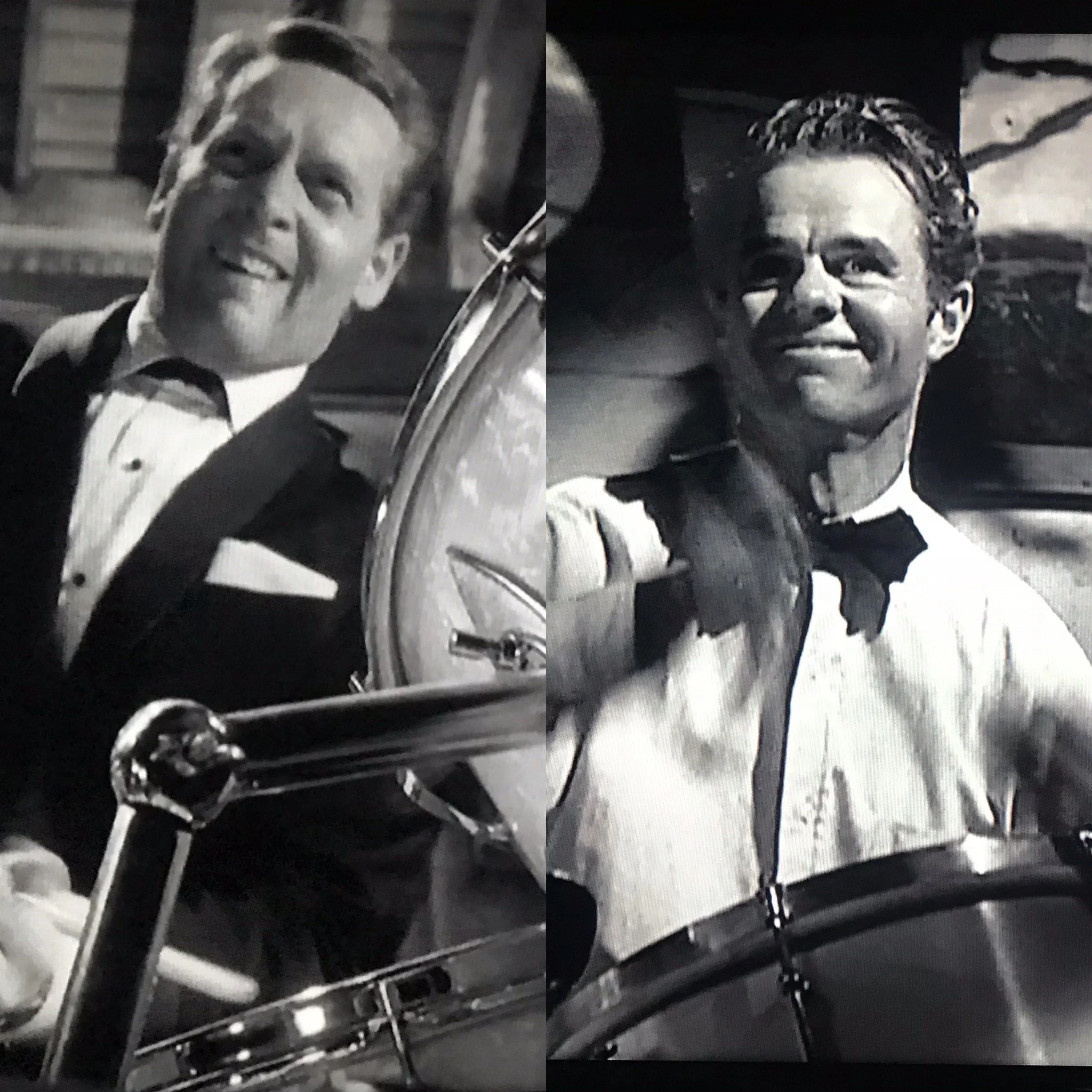
As Sapphire more explicitly used racial tensions, it also literally used color in what was the then novel Eastmancolor film stock (introduced in 1950). Yet for All Night Long, released three years later, Dearden goes back to the contrasts of black and white stock that were so strikingly highlighted in American noir films of the 40’s. Referencing the title character, and the race tensions of the play, in many ways All Night Long riffs on the noir genre. Although in the Dearden film, the usual lead of Othello is subjugated to the scheming Iago of Johnny Cousin (with McGoohan literally bouncing like a drumstick as the wired sociopath), Cousin is not portrayed as a sympathetic character, but more like a flawed, emotionally weak, bully (think Richard Widmark in Night and the City or Kiss of Death). From the oblique, interesting angles, and constantly moving visuals, to the underlying tension and deceptive activity by Cousin, Dearden and Relph appear to take the progressive racial stance of Jarrico and King, and fashion it into a then-contemporary take on classic noir. Like the best of that style, the dynamic camera movement and most significantly, the amazing jazz musicians and music (taking the cue from Elisha Cook Jr.’s drummer in Robert Siodmak’s Phantom Lady from 1944 – see Fig. 2), become more frenetic and percussive, and heighten the tension, as the personal conflicts and emotions become more heated. Adding to the atmosphere is the constant flow of “juice,” and smoking of pot by Cousin and Cass, and the continual downpour and thunder of the late-night rainstorm. Only Delia’s silky rendition of the title track, All Night Long, softens and smooths over the emotional stirrings, at least temporarily. Even the ending seems to borrow from the ambiguous and uncomfortable conclusion of often-filmed noir master penman Cornell Woolrich’s I Married a Dead Man(1948), where the husband and wife’s future looks uncomfortable and uncertain in the face of their mutual feelings of both love and mistrust.
Conclusion
The elements of Shakespeare gender roles reinterpreted, as well as transposing the racial politics from a military setting to the wholly realistic realm of jazz music make this film an extremely interesting musical version that builds on the Verdi opera, and inspires later takeoffs like the Jack Good-penned play and film Catch My Soul (1974), as well as a more contemporary hip-hop stage version of Othello (Isherwood, 2016). I have tried to cover some of the varied and complex topics and issues that Jarrico & King’s script seeks to coax out of the original Shakespeare plot. Plus Dearden and Relph add large dashes of visual style and flair, which the incredible and eclectic group of jazz musicians transcend to make the track and performances highlights of the piece. While All Night Long may not be a perfect film, it has many redeeming values that make it worth a viewing and rediscovery, for the many interesting aspects including the script, acting, cinematography, set design, and oh yeah…..the jazz, man…..
Fig. 2
References:
Blair, B. (2003). The memory of all that: Love and politics in New York, Hollywood, and Paris (1st ed.). Alfred A. Knopf.
Burton, A., & O'Sullivan, T. (2009). The Cinema of Basil Dearden and Michael Relph. Edinburgh University Press. https://doi.org/10.3366/j.ctt1r2750
Brubeck, D., Hayes, T., Dankworth, J., Mingus, C., Scott, J., Christie, K., Courtley, B., Dempsey, R., Ganley, A., Morgan, B., Happer, K., & Burbrook, C. (2015). Music from the sound track: All night long [Album]. Not Now Music Limited. (Original album released 1962 on Fontana Records)
Lees, G. (1995). Cats of Any Color. Oxford University Press, Inc.
Ceplair, L. (2007). The Marxist and the movies: a biography of Paul Jarrico. University Press of Kentucky.
Cukor, G. (Director). (1947). A double life [Film]. Kanin Productions.
Dearden, B. (Director). (1962). All night long [Film]. Roberts Pictures Inc.
Dearden, B. (Director). (1959). Sapphire [Film]. Artna Films Ltd.
Felsenthal, D. (2019, August 17). (Un)happy partners: On jazz and independent film. Los Angeles Review of Books. https://lareviewofbooks.org/article/unhappy-partners-on-jazz-and-independent-film
Földváry, K. (2020). Cowboy Hamlets & zombie Romeos. Manchester University Press.
Francis, J. (2008, October 11). Dave Brubeck and Charles Mingus – “Non-sectarian blues”. The Daily Record. https://joelfrancis.com/2008/10/11/dave-brubeck-and-charles-mingus-non-sectarian-blues/
Gabbard, K. (2016). Better git it in your soul (1st ed.). University of California Press. https://doi.org/10.1525/j.ctv1xxtdj
Hill, J. (1986). Sex, class and realism: British cinema 1956-1963. British Film Institute.
Hodgdon, B. (1991). Kiss me deadly; Or, the Des/demonized spectacle. In Vaughan, C., Vaughan, V. M., & Cartwright, K. (Eds.), Othello: New perspectives (pp. 214-255). Fairleigh Dickinson University Press; Associated University Presses.
Holden, S. (1987, February 22). Cabaret: Marti Stevens. The New York Times.
Howard, T. (2010). Shakespeare's cinematic offshoots. In Jackson, R. (Ed.), The Cambridge Companion to Shakespeare on Film (2nd ed., pp. 303-323). Cambridge University Press.http://dx.doi.org.libaccess.sjlibrary.org/10.1017/CCOL0521866006.018
IMDB. (2021). Alfred W. Crown. https://www.imdb.com/name/nm0189798/?ref_=fn_al_nm_5
Isherwood, C. (2016, November 16). Review: ‘Othello’ goes hip-hop. There’s humor, too. The New York Times Company. https://www.nytimes.com/2016/11/17/theater/othello-the-remix-review.html
Lanier, D. (2005). Minstrelsy, jazz, rap: Shakespeare, African American music, and cultural legitimation. Borrowers and Lenders, I(1).
Levenson, J. L. (2012). The society of women in the history of Othello from Shakespeare to Verdi. University of Toronto Quarterly, 81(4), 850–859. https://doi.org/10.3138/UTQ.81.4.850
McFarlane, B. (2007). Surviving after Ealing: The later careers of Basil Dearden and Michael Relph. Quarterly Review of Film and Video, 24(1), 65–71. https://doi.org/10.1080/10509200500486031
McGoohan, P. (Director). (1974). Catch My Soul [Film]. Metromedia Productions.
McGoohan, P. (Executive producer). (1967-1968). The Prisoner [TV series]. Everyman Films, Incorporated Television Company.
Shakespeare, W. (n.d.) The tragedy of Othello: The Moor of Venice. (Mowat, B.A. & Werstine, P., eds.). The Folger Shakespeare. https://shakespeare.folger.edu/shakespeares-works/othello/
Skrebels, P. (2008). "All Night Long": Jazzing around with "Othello" Literature Film Quarterly, 36(2), 147–156.
Wilkinson, P. (2017, June 23). All night long. Reelstreets. https://www.reelstreets.com/films/all-night-long/
Woolrich, C. (1982). I Married a Dead Man. Ballentine Books. (Original work published 1948)
Young, L. (1996). Fear of the dark: ‘Race’, gender and sexuality in the cinema. Routledge.